

Background
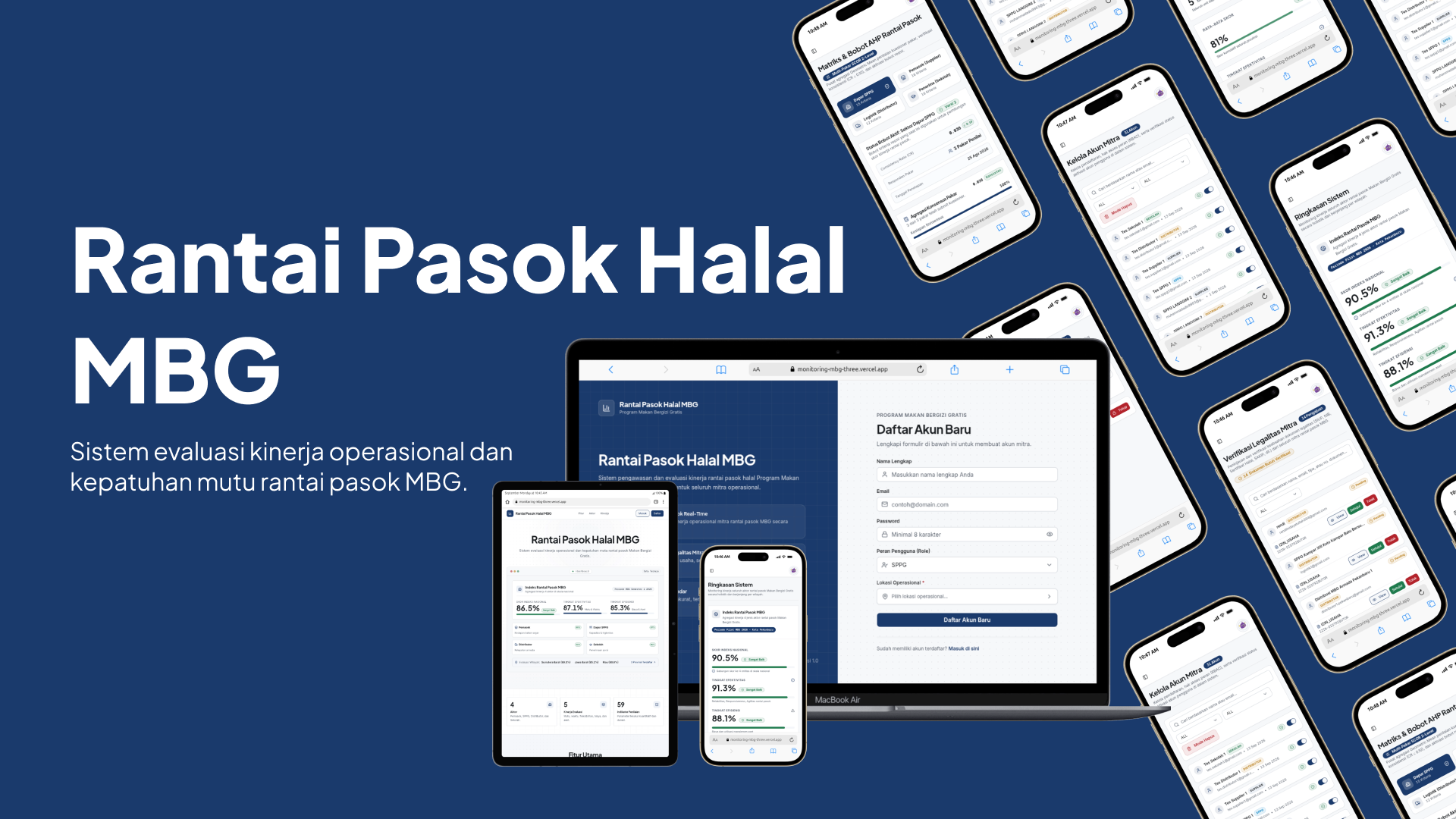
Rantai Pasok Halal MBG is a web-based Decision Support System (DSS) developed for academic research. It is designed to evaluate the operational performance and halal integrity of the supply chain for Indonesia’s national Free Nutritious Meals (MBG) program.
This system integrates SCOR metrics with a multi-level Analytic Hierarchy Process (AHP), enabling supervisors at various levels to evaluate the performance of four key actors: Schools, Distributors, SPPG (Kitchens), and Suppliers.
What I Work With
Building this application requires precision in calculations and knowledge of multi-level AHP to validate the results of the values used for decision-making. I often switch back and forth between Excel to make sure the calculations in Excel match those in the application, hehe. I also set up an AI agent at the beginning so that the generated code and design would remain consistent from start to finish.
- Next.js (App Router): Powers a high-performance Server Components architecture with strict proxy-based RBAC for 6 user roles.
- Tailwind CSS & Shadcn UI: Delivers a clean, data-dense enterprise dashboard with custom interactive controls like the dual-polarity Saaty slider.
- TypeScript & Zod: Enforces strict mathematical typing and runtime validation across multi-dimensional $N \times N$ comparison matrices and score calculations.
- Prisma ORM & PostgreSQL: Models complex relational schemas connecting 4 supply chain actors, spatial administrative hierarchies, and multi-tier performance scores.
- Cloudflare R2: Secure S3-compatible object storage handling audit compliance documents and halal certificates via presigned uploads.
- Vitest: Backs core business logic with a 152-unit-test suite ensuring 100% mathematical accuracy in eigenvector and composite score derivations.
Snapshots
Curated Works
MBG Supply Chain SCOR Metric Engine
Adapted the international SCOR framework to model Indonesia’s National Free Nutritious Meal (MBG) supply chain across 4 key entities: Food Suppliers, Central Kitchens (SPPG), Logistics Distributors, and Recipient Schools.
2-Level AHP & Consensus Engine
Engineered a hierarchical Analytic Hierarchy Process (AHP) pipeline to eliminate subjective bias and synthesize expert consensus into official national weights.
Halal & Food Safety Compliance Audit
Built an integrated regulatory verification and monitoring subsystem to ensure uncompromising food safety, hygiene, and halal integrity across every meal distributed.
Spatial Multilevel Analytics & Executive Intelligence
Designed interactive decision-making dashboards transforming multi-actor mathematical calculations into actionable spatial intelligence for government regulators.
Lessons Learned
Structuring Real-World Metrics with the SCOR Framework
I learned how the SCOR model structures complex supply chains into standardized dimensions like Reliability, Responsiveness, and Cost. This framework answered "what to measure," translating messy field operations—from meal delivery punctuality to kitchen hygiene—into structured, industry-standard performance indicators.
Implementing AHP and Enforcing Mathematical Consistency
I learned to implement the Analytic Hierarchy Process directly in code, calculating pairwise comparison matrices, priority eigenvectors, and $\lambda_{\max}$ from scratch. Most importantly, I learned to enforce the Consistency Ratio ($CR \le 0.10$), ensuring priority weights are backed by strict mathematical consistency rather than arbitrary inputs.
Integrating SCOR and AHP into a Unified Decision Engine
The biggest takeaway was synthesizing both methodologies: SCOR defines the hierarchy of indicators, while AHP calculates their relative importance based on expert consensus. Multiplying synthesized global weights by normalized field responses generates an objective, composite performance score (0–100) that stakeholders can trust.